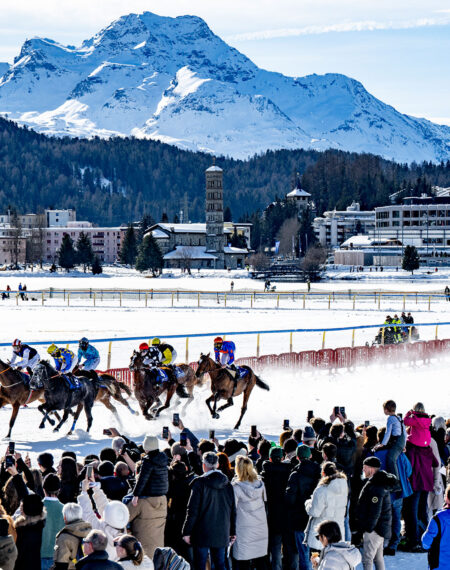
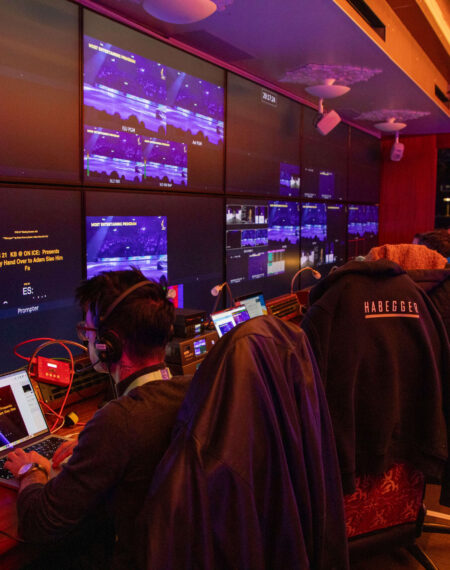
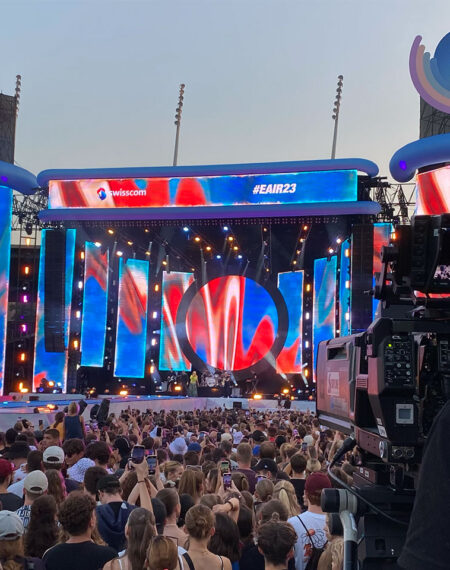
Events are meticulously staged – yet their impact often fades with the final round of applause. This is precisely where our broadcast solutions come into play: Broadcasting makes content usable and archivable beyond the moment, significantly expanding an event’s reach. In a conversation with Tomy Kögl, Head of Broadcast, it becomes clear what matters most and how broadcasting can be strategically leveraged.
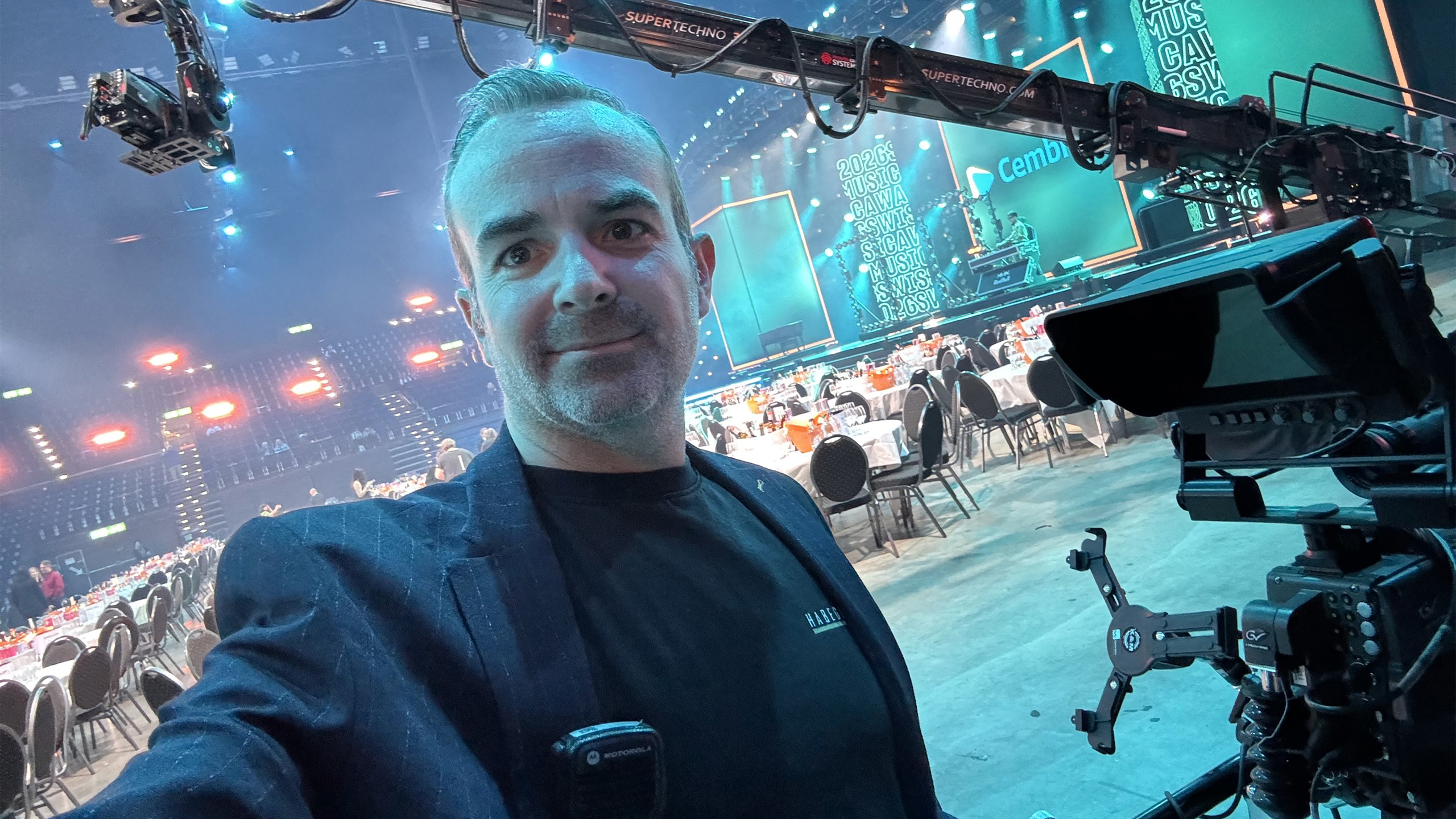
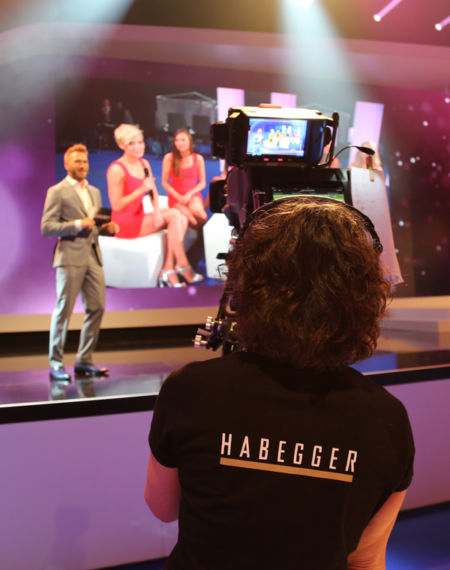
Tomy at the Swiss Music Awards 2026
Tomy brings over 25 years of experience in the broadcast industry. His career began in regional television and led him to international productions for organizations such as FIFA, the IOC, and UEFA, as well as to the corporate sector, working with clients like Swiss Life and Barry Callebaut.
Today, at Habegger, he oversees a wide range of broadcast formats – from live streams and hybrid events to complex international broadcasts.
Broadcast at Habegger works like Lego: You can start with one camera and scale up to 30 cameras or more. What matters isn’t the budget, but which solution truly adds value to the event.
The example of a fashion show illustrates how camera usage changes depending on the requirements. One camera provides the overall view, a so-called “beauty shot,” while others capture close-ups. As the action becomes more dynamic – for example, with several models walking in succession – additional cameras, different perspectives, and quick cuts are required. All in sync with the rhythm of the music.
Almost everything is scalable. We can handle smaller projects, but also larger ones.
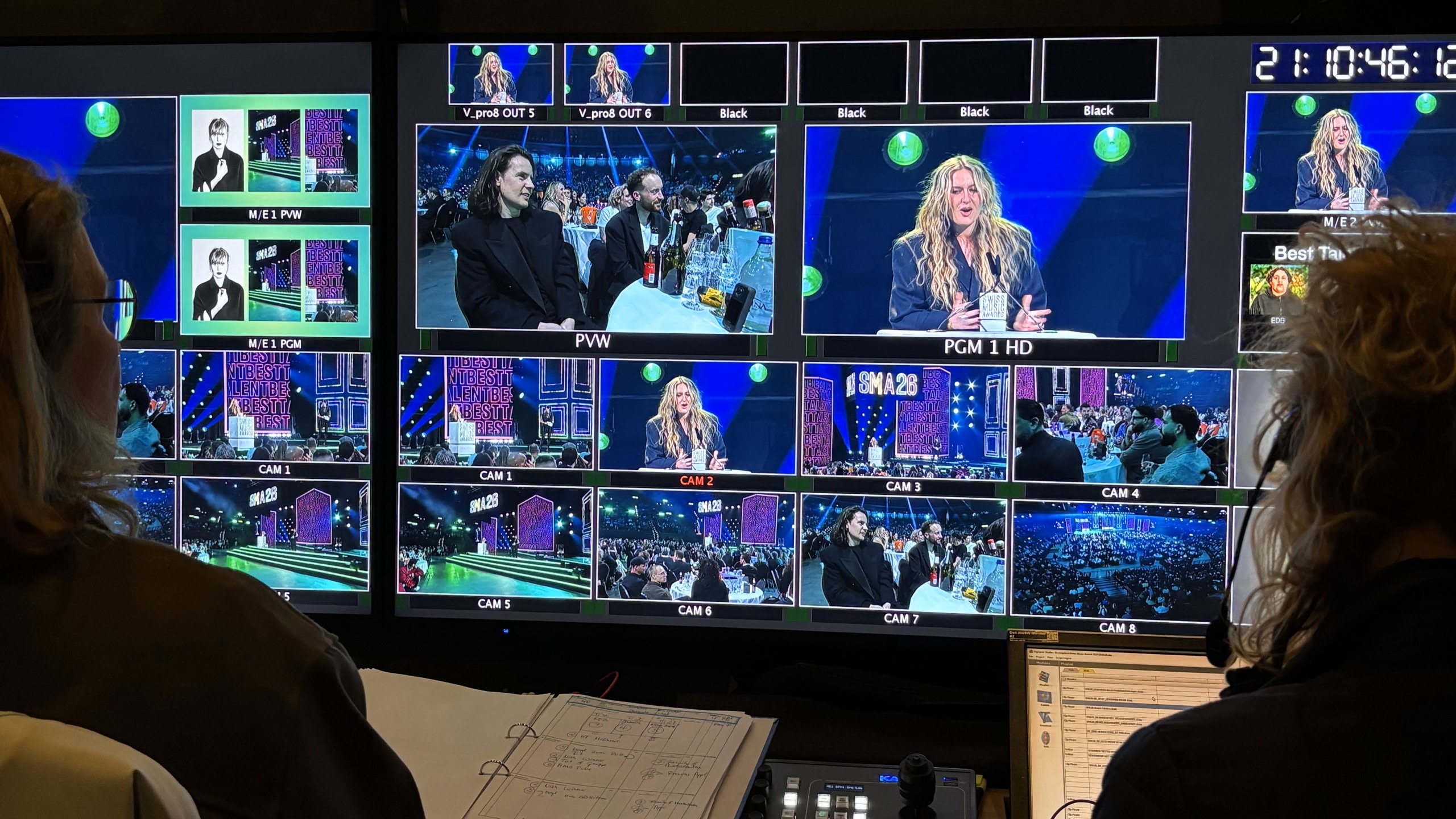
Broadcasting at the Swiss Music Awards 2026
At Habegger, broadcast services are not implemented in isolation, but are planned and executed as an integral part of the overall event production.
In a traditional event production, various disciplines typically work together – lighting, audio, rigging, broadcast, and even IT, which handles signal distribution. If these areas are not coordinated, problems arise at the interfaces. At Habegger, this runs smoothly because every client has a dedicated project manager who serves as the primary point of contact for all areas and coordinates them. The audio team knows what the broadcast team needs, and vice versa. Everyone knows and trusts one another. For example, the intercom specialist understands the IT requirements and their interfaces. This saves time, prevents errors, and enhances quality and production reliability.
One potential problem could be network congestion in the frequency bands. At events with tens of thousands of visitors – such as the Street Parade – everyone has a cell phone, is live-streaming on YouTube, and posting on Instagram. Wi-Fi access points are now installed everywhere; even modern vehicles are equipped with them. This reduces available bandwidth, which can affect wireless video transmissions, for example. Provider bandwidth quickly becomes overwhelmed.
We have three proven approaches:
That depends on the type of event. For major sporting events, it’s essential. For example: During a soccer match, advertising and TV licensing deals worth millions are being negotiated, and corresponding bets can be placed worldwide. The 80th minute – and the live feed goes down. No one knows whether they bet right or wrong, and the sponsor ads are missing. That would be a total disaster. In this case, broadcast isn’t just a nice-to-have – it’s critical to the system and the business.
Broadcast is also quickly becoming a must-have, because targeted use allows you to create better wow moments for the audience. A live event is a one-time thing, but with a good recording, you suddenly have:
 content for the website and social media
a valuable archive – as with the Montreux Jazz Festival, whose archive has been part of UNESCO’s “Memory of the World“ Register since 2013
a sales tool for next year: “Look how great our event was”
a basis for sponsorship negotiations
For many events, broadcasting offers an opportunity for additional revenue. For example, through live broadcasts and the advertisements aired during them.
The new perspectives that modern technology opens up. In the past, a production often consisted of just a camera on a tripod – and that was it. Today, we have drones, spider cams, high-speed and slow-motion cameras, which, combined with real-time graphic overlays, create real added value for the viewer.
A recent example: at the ice-skating show Art on Ice, we flew a drone over and through the skaters – creating perspectives that had never been seen before. At a ski race, a drone can fly alongside a skier at a similar speed. Suddenly, the viewer is “on the ski” – and the experience feels completely different.
Getting started with broadcasting is often easier than you might think. The necessary components are frequently already in use – adding recording capabilities can be done with minimal effort. In practice, however, we see that content is used live but not recorded. The need for it only arises afterward – by which point it’s too late.
My recommendation is therefore clear: Start with broadcasting. Even simple setups lay the foundation for use beyond the event itself and can be further developed as needed.
Today, broadcasting is no longer a question of “Can we do this?” but rather “How can we make the most of it?” The technical hurdles have been overcome. Modular scalability makes it accessible. But its true strength lies in the fact that professional broadcasting when done right – is not just a recording tool, but an added bonus for the event experience, reach, and value creation. And it does so under conditions that many would consider impossible.
Still have questions after reading? Tomy Kögl will show you how broadcast can be implemented specifically for your event — individually and tailored to your requirements.
Are you in the middle of planning your event, trade show, or visitor center, or do you have a rough, strategic idea but feel stuck? We offer a free 45-minute consultation with our experts. Together, we’ll conduct an analysis and ask the right questions. We’ll also provide you with the right tools.

Subscribe to our newsletter and follow us on social media.