As a scenographer at Habegger, Leonie designs concepts for spaces that are more than just backdrops – they tell a story. In this interview, she offers insights into her daily work, explains why she took a detour through architecture, theater, and film before turning to scenography, and discusses what shapes her perspective on spaces today.

Leonie began her career in architecture. However, she realized that something was missing. It wasn’t the design process itself – it was the lack of connection to the final result. That’s why she switched to theater before studying production design at the Film Academy Ludwigsburg. These experiences ultimately led her to set design.
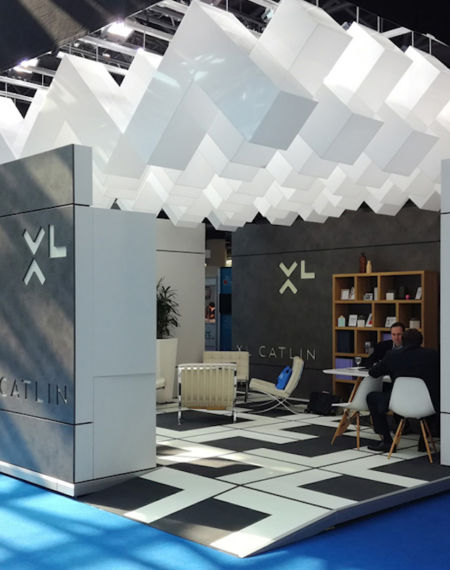
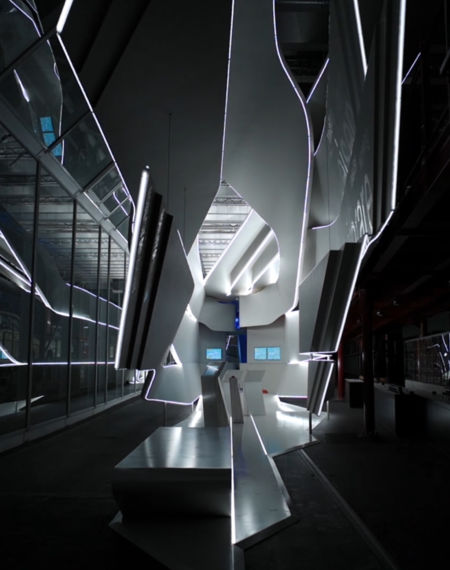
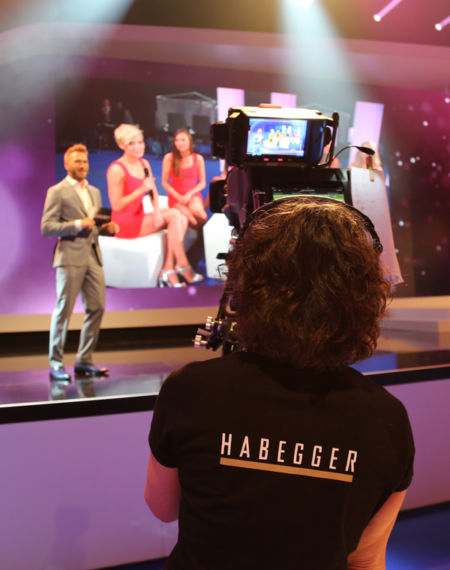
She was particularly influenced by the film industry: Leonie worked for nearly eight years on international productions such as The Hunger Games and The Queen’s Gambit in Berlin. During this time, she developed a keen sense for atmosphere, visual impact, and spatial dramaturgy – skills she now brings to bear at Habegger in events, visitor centers, and trade show booths.
For Leonie, the focus is never on individual objects, but rather on their interplay: spaces should convey a story and intuitively guide visitors through a staged environment. Light, proportions, materials, and wayfinding all interlock and shape how a space is experienced. It is precisely this holistic approach that is central to Habegger –through close collaboration with concept development, project management, technology, and creation, ideas are transformed into a cohesive overall experience.
Leonie therefore doesn’t think in terms of static backdrops, but in terms of sequences: How does a space begin? Where does it open up? How are people guided through a setting? For her, this is precisely the appeal of scenography – that design isn’t just visible, but becomes tangible.
Leonie spends a large part of her time at her desk, but she never loses sight of the end product. Working closely with clients and the Creation Team, she develops concepts, conducts feasibility studies, and translates ideas into real-world solutions. To ensure a positive experience in the end, a very practical approach is also essential. Materials must not only fit the concept but also align with the budget and timeline.
Good concepts don’t emerge in isolation from reality, but always in conjunction with technical, spatial, and financial constraints.
It’s not just about designing something, but about finding solutions. Spatial thinking, organization, and communication are therefore just as much a part of the job as a creative flair.
Leonie also considers the ability to stay calm under pressure to be important for the job. She cites time as the biggest stress factor: Often, several projects run in parallel, while the demand for quality remains high.
The highlight of the job is the moment when an idea transforms into a real space. When sketches, models, and 3D renderings from the “Unreal Engine” tool suddenly materialize before you – for example, at trade shows like the one for Skan, or in concepts for educational and experiential spaces. For the scenographer, it’s not the scale of the production that matters, but those moments when a design achieves its intended effect: when you enter a space, immediately grasp the message, and feel an emotion.
Leonie once felt that architecture lacked immediacy. Even though she now often works on temporary spaces in the event industry, she considers their impact and long-term influence from the very beginning. For her, sustainability doesn’t begin with implementation, but with the concept itself. Through modular systems, reusable materials, and the thoughtful use of existing elements, spaces are created that are designed for the moment but conceived and utilized far beyond it.
Leonie doesn’t describe her profession as a rigid job description. The paths into scenography are simply too varied for that – her own journey to Habegger clearly illustrates this. What becomes clear, however, is what it takes: strong spatial awareness, a feel for atmosphere, an openness to collaboration, and a willingness to continually engage with new places, themes, and challenges. It is precisely this combination that defines the profession.
Subscribe to our newsletter and follow us on social media.