As part of our campaign “Habegger Around the World”, we spoke with André Strebel, Project Manager for International Large-Scale Projects at Habegger. With over 25 years of experience in event technology and power management, he offers fascinating insights into how large international events are technically executed, what really matters in planning and logistics, and the challenges faced in different countries.
My career started in event technology, focusing on lighting and video. My first international assignment was in South Africa in 2009, shortly followed by the 2010 FIFA World Cup, which marked the beginning of my international projects. From then on, I practically only managed large-scale projects abroad. Today, I spend an average of 120 days a year overseas, and last year even 260 days.

Since South Africa, I have accompanied major international events every year—from sporting events such as the Champions League Final, International Olympic Committee, the Fan Zone in Doha, Beach Soccer Stars Award Night in Dubai, 2012 European Football Championship in Poland and Ukraine, and the London Summer Olympics, to corporate events. I’ve learned how crucial intercultural sensitivity, meticulous planning, and experience with complex technology and power supply are.
In Switzerland, almost anything can be organised within 24 hours—there’s hardly anything event-related that isn’t available or organisable. Abroad, it’s completely different: there, networking, experience, improvisation, and sometimes a bit of luck count.
For example, for a project in Buenos Aires, printed materials had to be reproduced at short notice. The samples looked perfect at the local manufacturer, but the actual quality was far from it. In the end, we had the prints made in Germany, flew two trainees over, and collected the delivery directly at the airport. Situations like this show that mistakes always happen—you need steady nerves and a solution-oriented mindset. The key is how quickly you react and still manage to pull off the event without a hitch.
Because at the scale we operate, no event is ever postponed.
The biggest hurdles are logistics, travel formalities, customs, and the widely varying local standards. In some countries, there are only a few suppliers or hardly any expertise, so we have to ship entire containers from Switzerland—sometimes even cheaper than renting locally. Climatic conditions, tight spaces, or difficult infrastructure add further complexity. Each country brings its own technical, logistical, and cultural challenges.
Many countries don’t have an established event industry like Switzerland. Regulations are often unclear, incomplete, or borrowed from other sectors—such as construction—which makes temporary power installations particularly challenging. To successfully execute international projects, we bring our Swiss standards abroad, covering safety, material quality, and technology.
A central part of my work is personally checking local suppliers and warehouses. I verify what materials are truly available and whether they meet our requirements. Only this way can we ensure that quality and reliability are maintained at the same high level internationally.
Meticulous preparation is key. I gather information in advance about regulations, cultural specifics, and potential obstacles. Contacts, networks, and ongoing exchange with colleagues who have already worked in the region are extremely helpful.
Particularly important is our AV Alliance network and preferred network suppliers, who operate worldwide rental networks. This way, we know the quality is right and we can rely on partners everywhere.
Within the team, we must always focus on what we, as service providers, must deliver and what the client expects. Companies don’t execute their international projects with us by chance—they want the same quality abroad that they are used to in Switzerland.
Extremely important. Cultural differences are huge—whether in the Middle East, North America, or South America. People work, live, and communicate differently. You have to adjust, or it won’t work. Intercultural adaptability is just as important as technical expertise.
The biggest obstacle is usually interpersonal: arrogance is always out of place, adaptation is required. Large projects always require a healthy dose of composure, which you must not only maintain to yourself but also radiate to others. Only then does the client feel the confidence that is crucial for a successful event.
Definitely the International Olympic Committee 2017 in Lima. We had to equip seven floors of a single building simultaneously—logistically a nightmare! On top of that, eight containers of materials came from Switzerland because there simply weren’t enough locally.
What was particularly impactful, however, was the human aspect: what we achieve with five people in Switzerland requires 20–25 there. Not due to lack of expertise, but to give as many people as possible work to support their families. Experiences like this broaden your perspective beyond purely technical considerations.
The variety. Each project brings new conditions. It’s always a fresh challenge, never monotonous. Developing solutions that work everywhere and experiencing the moment when technology, crew, and concept come together perfectly is thrilling. Even recurring projects are never identical. It’s like bungee jumping—always an adrenaline rush, and that’s exactly what makes the work exciting.
We are known in the industry for being extremely precise and detail-oriented. Every contingency is accounted for, every solution double-checked.
Our expertise covers not only planning but also continuous monitoring during events.
We analyse power load curves to respond to fluctuations early, ensuring maximum safety for all technical systems.
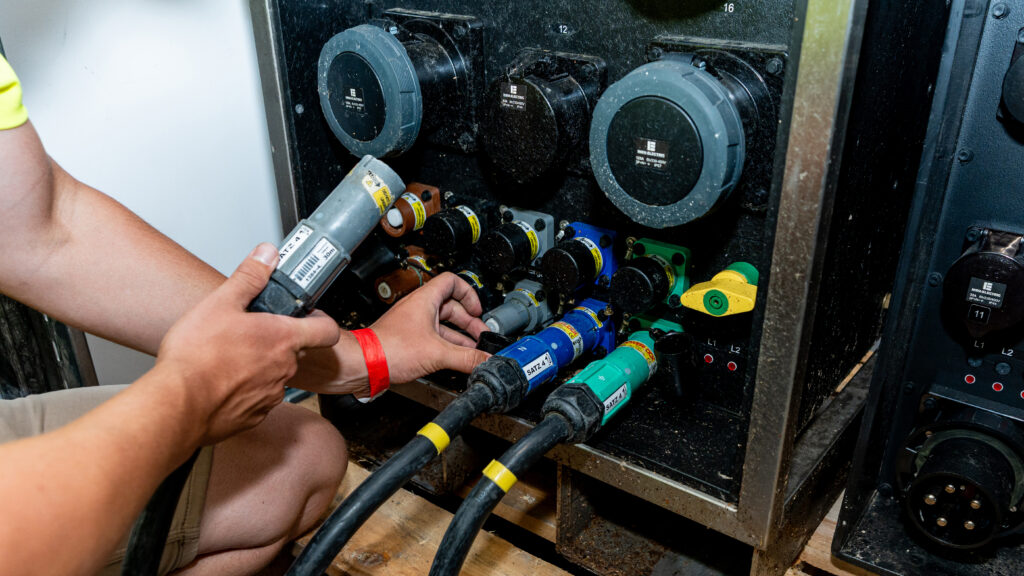
In power management, there are no compromises. Power grids and voltages vary by country, as do grid stability and safety standards. From the start, we plan complete redundancy systems: generators, UPS units, and battery buffers ensure all critical systems—video servers, signal chains, or mixing consoles—can operate continuously. The most expensive and sensitive equipment is additionally protected. A power outage must never stop lighting, communication, or broadcasting.
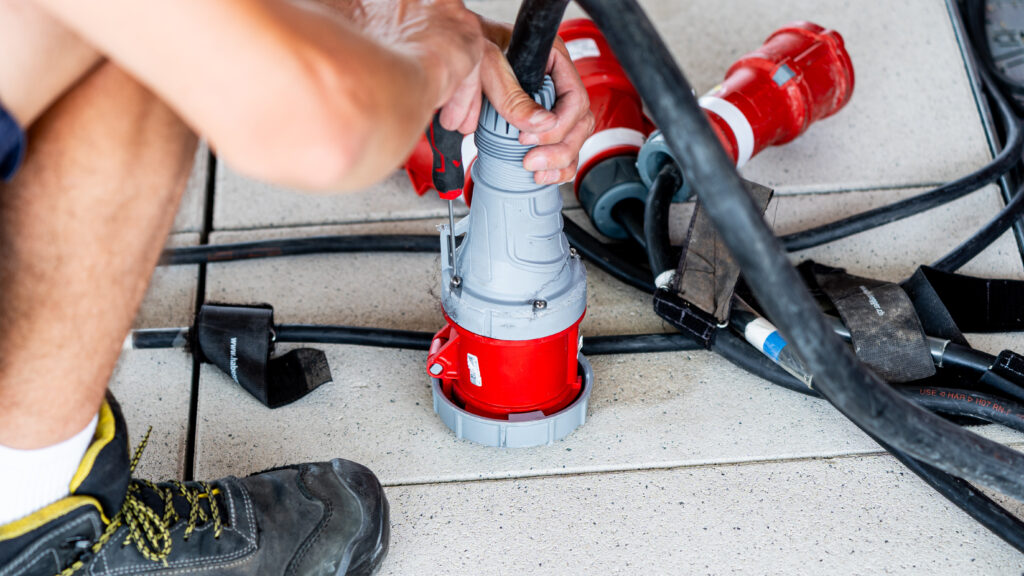
Safety is also central: RCDs (residual current devices), which are standard for us, are completely absent in many countries. We integrate such standards consistently—just as our clients are used to in Switzerland.
Back then we used to handle two to three international large-scale projects per year, today it’s around 50. This experience is one of our biggest USPs and the reason clients trust us worldwide.
At international large-scale events, power supply and communication are the most critical points. Everything must run smoothly: intercom, radio connections, signal transmission. Relying on WhatsApp alone could collapse a fully packed stadium. That’s why we recommend an internal communication network—the investment pays off. Even if external services fail, we can manage all critical operations.
My recommendation is to involve the responsible planners as early as possible. The more time, the better we can avoid obstacles. A site visit is mandatory: only by seeing the situation firsthand do you know what you’re dealing with.
Regarding power: it’s better to check too much than too little. Verify grid stability, necessary redundancies, and available outage statistics. Power management is not only technical but also a safety matter. No electricity, no event.
International events are challenging but incredibly exciting. No project is the same—new cultures, new conditions, new teams. Those who combine composure, flexibility, and meticulous planning create unforgettable experiences for audiences. Personally, the best moment is when everything works, the event runs smoothly, and the audience is thrilled—that’s when I know we’ve done a good job.
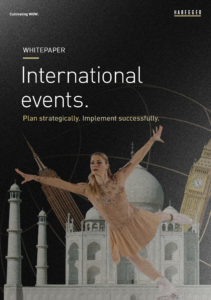
International events are complex – but manageable. In our whitepaper, you’ll learn what truly matters to ensure your project is executed professionally, efficiently, and with strong brand impact worldwide.
Subscribe to our Newsletter and follow us on social media.